ESP (Electrical Submersible Pumps) End To End
Mastering Electric Submersible Pumps
ESP System: End-to-End Training Program
With Iraqi Field Applications
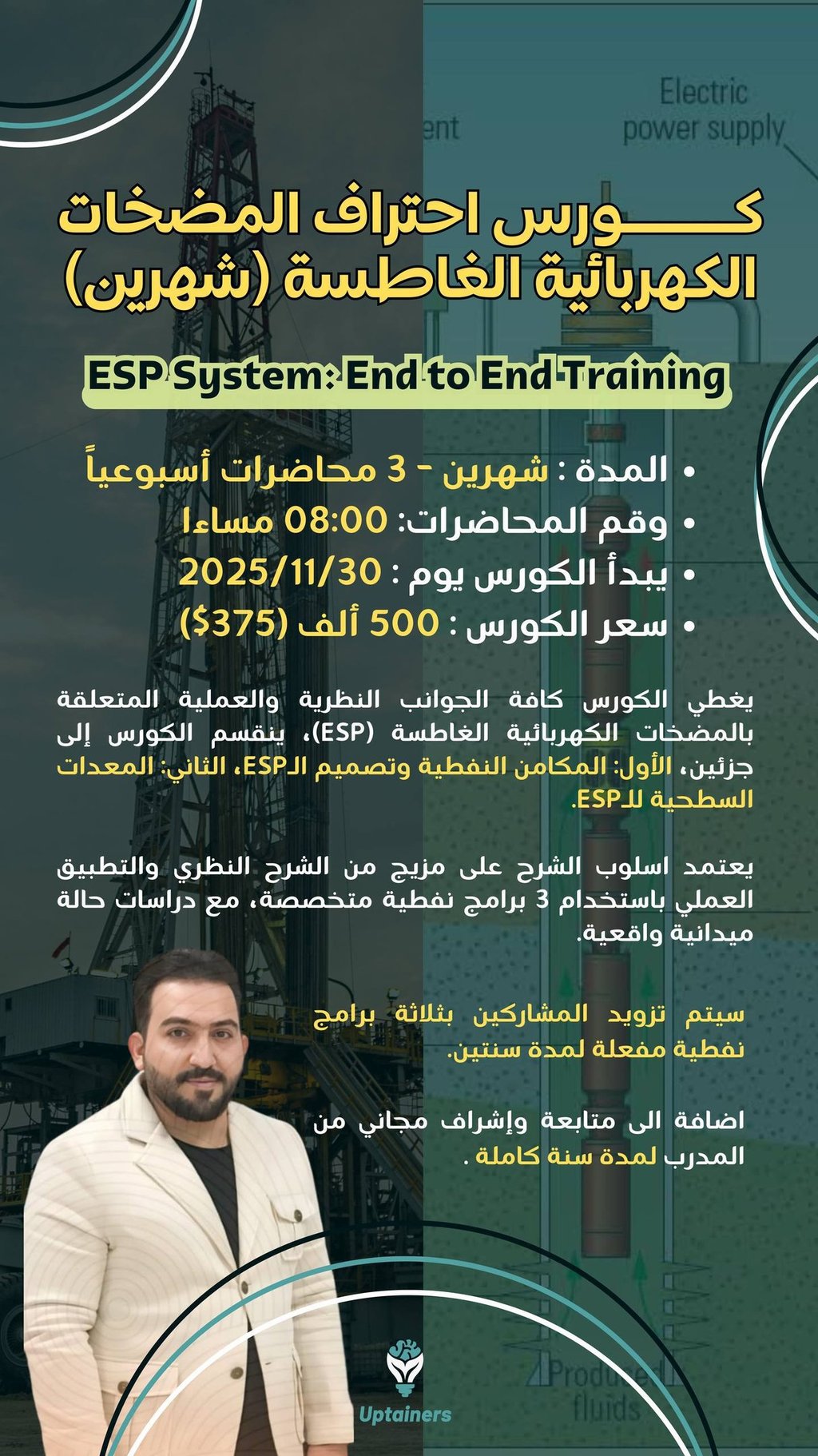
Duration: 2 months
Instructor: Eng. Omar Khalid
(More than 10 years of experience in the oil & gas industry, MSc in Petroleum Engineering)
Scientific Course Details
This comprehensive two-month training program covers all theoretical and practical aspects of Electric Submersible Pumps (ESP), with a strong focus on real Iraqi oilfield applications.
The course is divided into two main parts:
Part One: Reservoir Engineering & ESP Design
Linking reservoir characteristics to ESP selection and operation
Fundamental principles and standards of ESP design
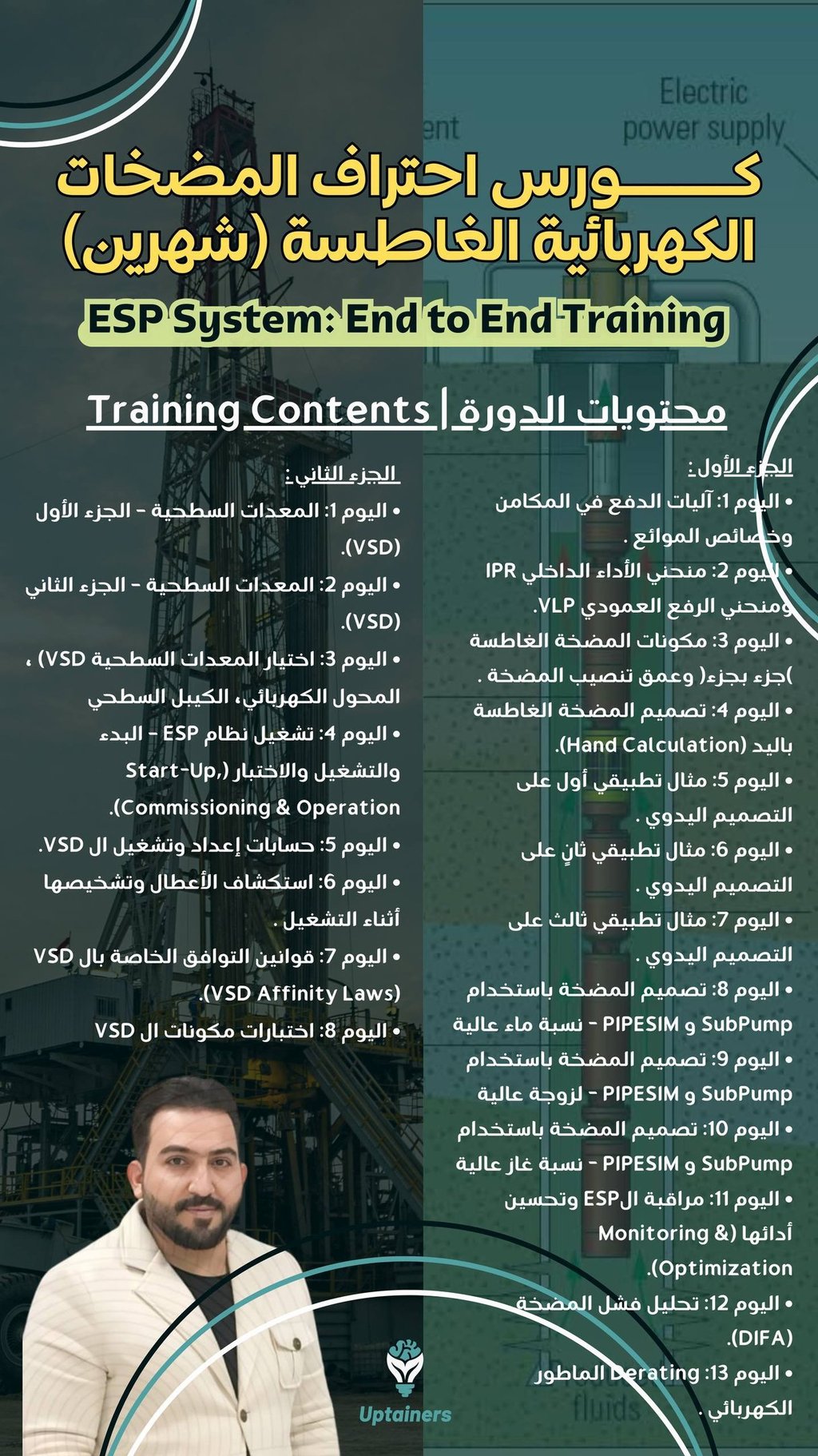
Part One Content:
Day 1: Reservoir drive mechanisms and fluid properties
Day 2: Inflow Performance Relationship (IPR) and Vertical Lift Performance (VLP) curves
Day 3: ESP components (part by part) and pump setting depth
Day 4: ESP design using hand calculations
Day 5: First practical example of hand design
Day 6: Second practical example of hand design
Day 7: Third practical example of hand design
Day 8: ESP design using SubPump and PIPESIM – High water cut case
Day 9: ESP design using SubPump and PIPESIM – High viscosity case
Day 10: ESP design using SubPump and PIPESIM – High gas ratio (High GOR) case
Day 11: ESP monitoring and performance optimization
Day 12: ESP failure analysis (DIFA)
Day 14: Electric motor derating
Part Two: ESP Surface Equipment
Detailed study of control, monitoring, and management systems
Comprehensive explanation of surface equipment associated with ESP operation
Part Two Content:
Day 1: Surface equipment – Part 1 (VSD)
Day 2: Surface equipment – Part 2 (VSD)
Day 3: Selection of surface equipment (VSD, transformer, surface cable)
Day 4: ESP system start-up, commissioning, and operation
Day 5: VSD setup and operation calculations
Day 6: Troubleshooting and fault diagnosis during operation
Day 7: VSD affinity laws
Day 8: VSD component testing
Training Details
Duration: 2 months
Schedule: 3 lectures per week, each lecture 1.5 hours
Methodology: A combination of theoretical explanation and hands-on practical application using three specialized petroleum software packages, supported by real field case studies
Assignments: Home exercises and tasks to reinforce practical understanding
Key Benefits:
Full access to all scientific training materials
Provision of three activated petroleum software packages for two years
Free follow-up and supervision by the instructor for one full year

🎥 Introductory (free) lecture about the course